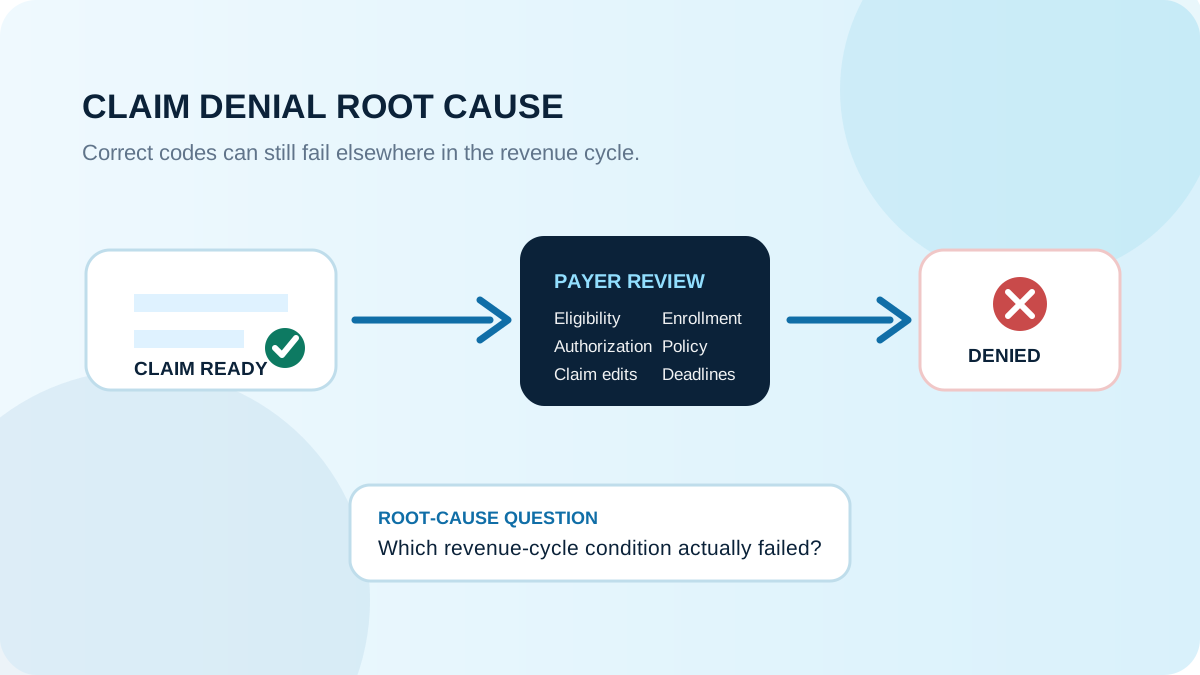
Prior authorization creates one of the most dangerous gaps between clinical scheduling and revenue-cycle execution. A patient can be scheduled, clinically appropriate for treatment and actively insured, yet the claim can still deny because the payer required approval before the service, the approved details did not match what was performed, or the practice could not prove the authorization conditions were met.
In 2026, the operational importance is even clearer because CMS's Interoperability and Prior Authorization Final Rule is moving certain impacted payers toward more standardized prior-authorization processes, faster decision timeframes and API-based information exchange. Those changes can improve the process, but they do not eliminate the practice's responsibility to verify requirements and document what was approved.
1. Verify coverage before checking authorization
Authorization workflow should begin with accurate eligibility and benefits. Confirm that the patient's plan is active for the expected date of service and identify the correct payer/product. Then verify whether the specific service requires prior authorization, precertification, notification, referral or another utilization-management step.
Do not rely on the patient's card alone. Employer groups, plan products, delegated networks and benefit administrators can route authorization differently even under familiar payer brands.
2. Confirm exactly which service is planned
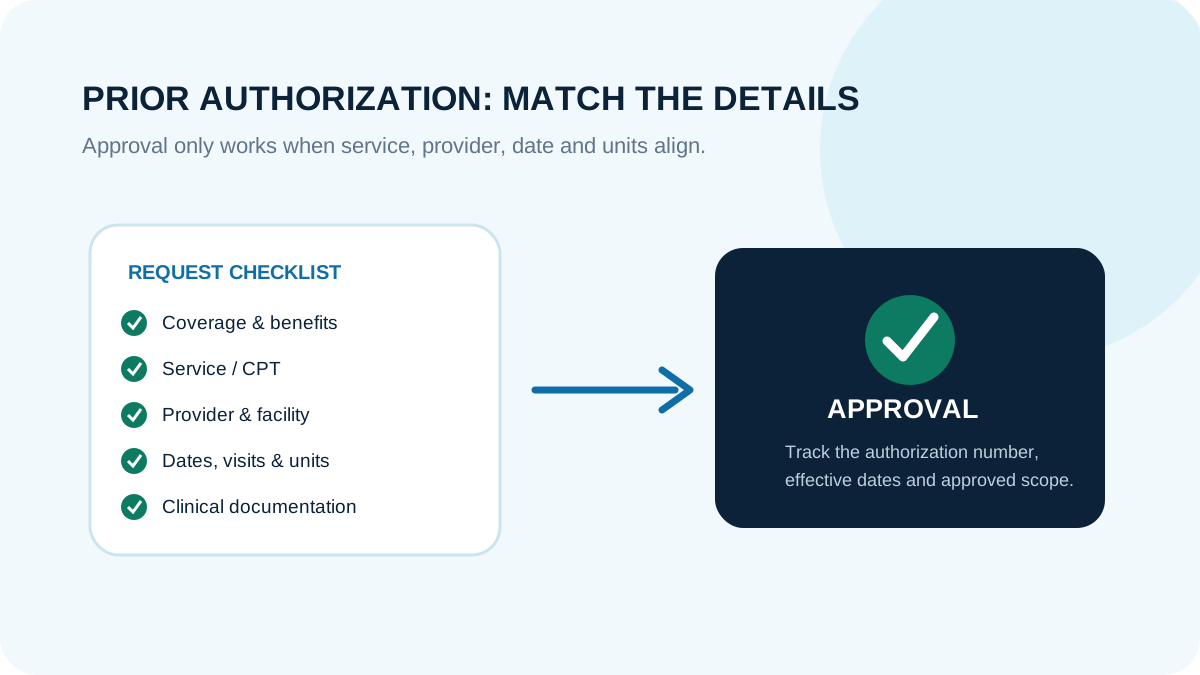
Authorization teams need sufficient clinical and scheduling information to request the correct service. Depending on the payer, this can include procedure/service, diagnosis, laterality, units, frequency, date range, place of service, facility and servicing/rendering provider.
If the treatment plan changes after authorization, the approval should be rechecked. A request approved for one code, site or number of visits may not automatically cover another.
3. Match the provider and facility to the approval
An authorization may be tied to a particular rendering provider, billing entity or facility. Before the service is delivered, confirm that the approval aligns with the actual care setting. This becomes especially important when schedules change, providers cross-cover, procedures move between locations or an outside facility is used.
4. Track dates, visits and units
Many authorization failures are not “no authorization” failures. They are mismatch failures: the approval expired, approved visits were exhausted, units were exceeded or the service fell outside the approved date range.
A useful authorization tracker should make these limits visible before the next appointment is delivered. For recurring therapy, infusion, pain management and other multi-visit services, remaining units/visits should be part of the scheduling workflow rather than discovered after denial.
5. Build the request around payer criteria and clinical documentation
Prior authorization is an administrative process, but the decision often depends on clinical information. The request may need diagnosis, symptoms, prior treatment, test results, medication history, failed conservative therapy or other evidence. The documentation supplied should address the payer's stated criteria rather than sending a large chart without a clear clinical story.
If the payer requests additional information, assign ownership and a deadline immediately. An authorization request can stall simply because the request for records or clarification sits in a portal inbox.
6. Record more than the confirmation number
For every authorization, document the payer, method of submission, reference/authorization number, approved service, dates, units/visits, provider/facility, status, representative or portal evidence where available, and any limitations or special instructions. If no authorization is required, document the source and date of that verification as well.
7. Distinguish pending, approved, denied and no-auth-required statuses
Scheduling staff should not have to interpret free-text notes. Use clearly defined statuses and escalation rules. A pending request close to the service date needs a different action from an approved request, and a denied request needs a clinical/administrative pathway before the patient simply proceeds as if approval exists.
8. Understand what CMS's 2026 prior-authorization changes do—and do not—mean
CMS's final rule applies to specified impacted payers and includes requirements around prior-authorization information exchange, decision timeframes and denial reasons, with implementation dates varying by provision. CMS states that certain operational prior-authorization requirements begin in 2026, while many API requirements are required beginning primarily in 2027.
Practice leaders should not interpret this as “prior authorization is now automatic” or “all commercial plans follow one rule.” Instead, use the changes as a reason to modernize tracking and make payer-specific requirements easy for staff to verify.
9. Connect authorization status to claim submission
Before claim release, authorization information should be available to the billing workflow where required. If the billed service differs from the approved service, stop and investigate before assuming the payer will reconcile it automatically. Claim submission should reflect the actual documented service and the applicable payer requirements.
10. Perform root-cause review on every authorization denial pattern
Authorization denials should be categorized. Was authorization never requested? Was it requested too late? Was the wrong service approved? Were units exhausted? Did the service change? Was documentation insufficient? Was the wrong provider/facility attached? Did the payer make an error despite documented approval?
That distinction matters because the prevention strategy is different. Training staff to “get authorizations” will not fix a recurring units-exhausted problem or a provider-location mismatch.
A practical pre-service authorization checklist
- Coverage active for expected date of service.
- Correct plan/product and authorization vendor identified.
- Authorization/referral requirement verified for the specific service.
- Requested CPT/service, diagnosis and clinical indication confirmed.
- Rendering provider and facility match planned service.
- Approved dates are valid.
- Approved visits/units are sufficient.
- Required records/criteria submitted.
- Approval/no-auth-required evidence documented.
- Authorization status visible to scheduling and billing teams.
- Any treatment-plan change triggers re-verification.
What practice leaders should monitor
Useful measures include requests submitted, pending cases, average turnaround, services delayed for authorization, denials caused by missing authorization, denials caused by mismatch, expired approvals, exhausted units and overturn outcomes. These measures show whether the authorization process is protecting both patient access and revenue.
A strong authorization workflow is not about adding administrative steps. It is about completing the right administrative step early enough that clinical care and claim payment are less likely to collide later.